

Water-related fatalities in children and young people under 25 years of age, Wales, 2013 to 2022
Published on: 3rd July 2023
- All Wales/National
This report is to help inform the work of water safety professionals in Wales to prevent future deaths of children and young people from water-related fatalities.
Background
The aim of this report is to help inform the work of water safety professionals in Wales to prevent future deaths of children and young people from water-related fatalities.
The death of a child or young person has devastating and life changing impacts on families and the wider community. Drowning is the second most common cause of non-intentional injury fatalities in children under 18 years of age in Wales, after transport related fatalities.1
The Child Death Review Programme, Water Safety Wales and RoSPA noted five deaths of children under 18 years of age from drowning in 2022. This was higher than in previous years, which led to them working in partnership to produce this report.
The Child Death Review programme published the Thematic review of deaths of children and young people through drowning in 2016 and made a series of recommendations.
Good progress has been made towards many of the recommendations including the establishment of an all-Wales forum for water safety.
An existing Water Safety group expanded into Water Safety Wales which consists of around 40 organisations.
Water Safety Wales developed the Wales Drowning Prevention Strategy (2020-2026) and there are numerous examples of drowning prevention and water safety activities aimed at children and young people in Wales (Link to WSW list of activities for CYP).
Parent story
Carli Newell lost her 11-year-old son Zac Thompson in summer 2022.
Carli said:
“As a 36-year-old mother of two boys, I have resided in Pembrokeshire, West Wales, my entire life and currently hold the position of a journalist for a local newspaper.
 “On the evening of 1st July 2022, Zac, along with his elder brother, cousin, and another local boy, were playing at the football field in Angle. Upon walking their friend home, who resides adjacent to the beach, the boys decided to perch upon the rocks and observe the sunset. With no intention of entering the water, they neglected to inform anyone before venturing to the beach.
“Shortly after 9pm, an unexpected wave forcefully swept Zac, his brother, and cousin into the water. Fortunately, his brother and cousin managed to clamber onto nearby rocks. Sensing Zac’s struggle, his elder brother advised the cousin to run to the beach and seek assistance.
“Without hesitation, his brother plunged back into the water, swimming towards Zac and instructing him to grasp his foot. Together, they swam towards the rocks until, just as his brother reached for a rock, another powerful wave separated them, dragging Zac farther out into the water where he became trapped in a whirlpool.
“Despite the combined efforts of numerous medical professionals, members of the public and a significant presence of emergency services, Zac never regained consciousness and succumbed to his injuries in the hospital on 2nd July.
“Zac’s tragic and abrupt passing has inflicted indescribable devastation upon our family, tearing the very core of those who knew and loved him. Following news of Zac’s passing, the entire community was consumed by grief. A year on, the impact of Zac’s death is still palpable within our community.
“However, a charity has been established in his honour called Forever 11, which is dedicated to imparting water safety awareness to children and young individuals. Zac remains affectionately remembered by all who knew him, with several memorial matches held in the sports he adored, a tradition that will endure for years to come.
“Zac possessed an infectious personality; funny, cheeky, intelligent, kind, and extremely courageous. Despite his small stature, he emanated a larger-than-life aura, drawing people towards him.
“In a nation blessed with fantastic beaches, bays, harbours, lagoons and inland waters, the significance of water safety and education regarding appropriate actions during emergencies cannot be overstated.
“The latest statistics concerning accidental drownings in Wales paint a bleak picture, particularly for children and young individuals, especially boys. It is heart-wrenching to witness the number of water-related fatalities in children and young people in Wales in recent years.
“Clearly, more can be done to decrease these rates and safeguard our children as they revel in and respect the water.
“I support this report and urge everyone to read its evidence carefully and consider what more they can do to help children and young people enjoy the water safely.”
Measuring the data
Data sources
Data were obtained from the Water Incident Database (WAID) and the Child Death Review Programme (CDRP). WAID is web-based data collection, gathering water-related incident data from a wide range of sources within the UK search and rescue region for all ages.
A more detailed description of the system can be found at om the National Water Safety website. CDRP collects information on deaths of children under 18 years of age, it includes all deaths (or events that lead to death) that occur in Wales, and deaths of Welsh-resident children who die outside of Wales.
A more detailed description can be found on the child death review page. Data between the WAID and CDRP databases were cross referenced and cleaned for children under 18 years of age.
Data analysis
Inclusion criteria: water-related fatalities in children and people under 25 years of age between 1 January 2013 and 31 December 2022 where the event leading to death occurred in Wales (or occurred outside of Wales in children under 18 years of age).
The main analysis of data in this report was based on non-intentional (‘accidental’ or natural causes) water-related fatalities that occurred in Wales from 2013 to 2022 and described the characteristics in terms of time, person, and place. Where appropriate, the mean (average) number of cases and standard deviation were calculated. It is expected that a number is within one standard deviation above or below the mean two thirds of the time. This gives a measure of whether there are counts or trends of concern.
It was not possible to calculate rates as the denominator was unknown as some of the children and young people were non-Welsh residents. The average annual population for comparison of the proportion of fatalities in each age group compared with the proportion of children and young people in each group in the population used Welsh population data as a proxy measure, even though it is noted that not all the fatalities were Welsh residents.
Intentional water-related fatalities, and fatalities of Welsh resident children that occurred outside Wales were briefly described.
Strengths and limitations
Strengths
- Data from two different sources, CDRP and WAID, were used for fatalities under 18 years of age, which enabled cross referencing of data and cleaning of data for this age group.
- Both CDRP and WAID are national level population-based registries.
Limitations
- CDRP does not include data on children and young people 18 or over, so it was not possible to cross reference the data for the 18-24 years age group.
- Data on ethnic group was only available for children under 18 years of age (via CDRP) but was around 50% incomplete therefore it was not possible to include in this report.
- Data on area of residence was not available for the 18-24 years age group.
- It was not possible to calculate the rate of water-related fatalities.
- There were a relatively small number of fatalities, so caution needs to be exercised when drawing conclusions from the data. Changes in small numbers due to natural variation can lead to large percentage changes so may appear to be more significant than they are.
Findings
There were 86 water-related fatalities in children and young people under 25 years of age that occurred in Wales between 2013 and 2022.
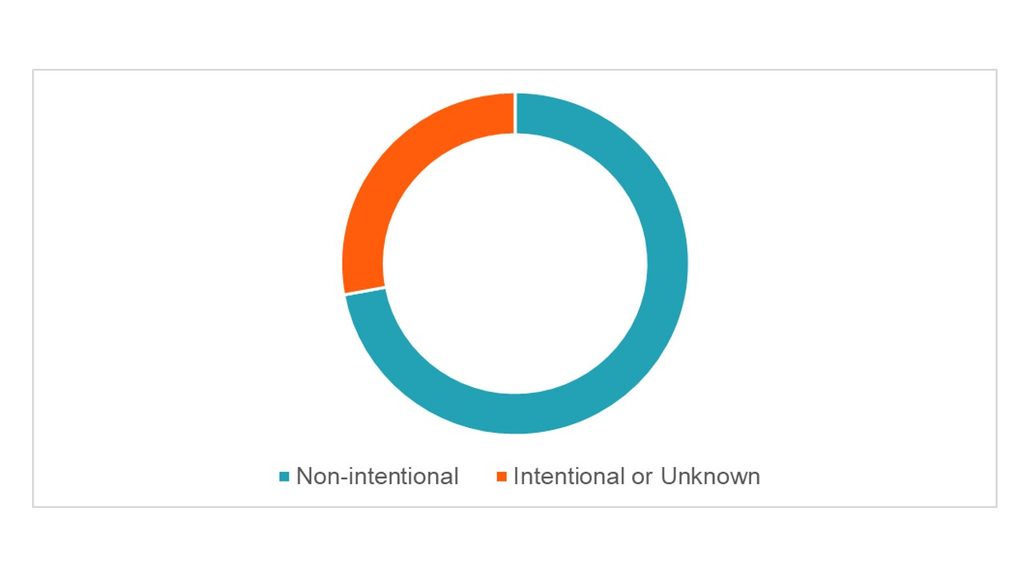
62 deaths were non-intentional (‘accidental’ or natural causes) and 24 were either intentional (suspected suicide or deliberately inflicted) or unknown (fig. 1).
Less than five non-intentional water-related fatalities of Welsh-resident children under 18 years of age occurred outside of Wales during the same ten-year period. This figure is unknown for the 18-24 years age group.
This report will focus on the 62 non-intentional water-related fatalities in children and young people that occurred in Wales, with findings presented by time, person, and place.
Fig 1. Proportion of non-intentional (‘accidental’ or natural causes), intentional (suspected suicide or deliberately inflicted) and unknown water-related fatalities in children and young people, Wales, 2013-22. (Produced by CDRP, using CDRP and WAID data).
Findings – time
Non-intentional water-related fatalities by year, season, and day of incident
Year
There were between three and nine fatalities per year during the 10-year period in children and young people under 25 years (fig 2).
The lowest number of fatalities occurred in 2020 when there were three, and the highest number of fatalities occurred in 2016 when there were nine. The number of water-related fatalities recorded each year is small and the data can fluctuate over time, therefore any year-on-year changes should be interpreted with caution.
For children under 18 years of age (not shown separately), there were between one and five fatalities per year during the 10-year period. The lowest number of fatalities occurred in 2017 when there was one, and the highest number of fatalities occurred in 2022 when there were five.
Fig 2. Count of non-intentional water-related fatalities in children and young people, Wales, 2013-22, by year of incident. (Produced by CDRP, using CDRP and WAID data).
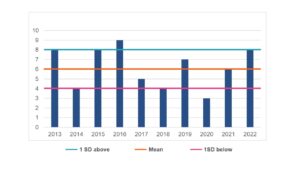
Mean and standard deviation: The mean number of fatalities per year over the 10-year period in children and young people under 25 years of age was six, and the standard deviation was two. The three fatalities in 2020 were outside of one standard deviation below the mean. The nine fatalities in 2016 were outside one standard deviation above the mean. In every other year, the number was within one standard deviation. It is expected that around one third of the time the number would be outside one standard deviation of the mean, so the variation in numbers is what would be expected.
The mean number of fatalities per year over the 10-year period in children under 18 years of age was three per year, and the standard deviation was one. The one fatality in 2017 was outside of one standard deviation below the mean. The five fatalities in 2022 were outside one standard deviation above the mean. Although it would be expected that around one third of the time the number would be outside one standard deviation of the mean, it will still be important to monitor this in the future to determine whether there is an upward trend.
Season
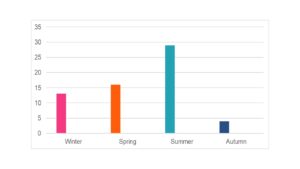
Almost half (29 out of 62, 47%) of all fatalities occurred during the summer months (June to August) (fig. 3).
Fig 3. Count of non-intentional water-related fatalities in children and young people, Wales, 2013-22, by season of incident. (Produced by CDRP, using CDRP and WAID data).
Day
Fatalities most commonly occurred on a Sunday (fig. 4).
Fig 4. Count of non-intentional water-related fatalities in children and young people, Wales, 2013-22, by day of incident. (Produced by CDRP, using CDRP and WAID data).
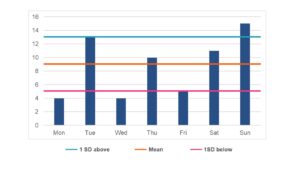
Mean and standard deviation: The mean number of fatalities per day was nine. Three out of seven weekdays were outside one standard variation of the mean which is more than would be expected. Sunday was outside of one standard deviation above the mean. However, a peak at the weekend would be expected.
Findings – person
Non-intentional water-related fatalities by age and sex
The majority of the 62 fatalities occurred in males, who accounted for 49 (79%) fatalities.
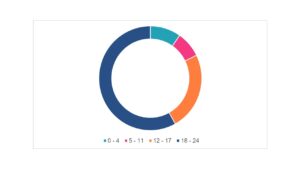
Over half (36 out of 62, 58%) (fig. 5) of the children and young people were in the 18-24 years age group, even though the proportion of young people in this age group accounted for less than one third of the average annual population (2013-22) of children and young people aged 0-24 years of age.2 If it is expected that the proportion of fatalities in each age group was similar to the proportion of children and young people in each age group in the average annual population, the 18-24 years age group were over represented.
Nearly a quarter of the children and young people (15 out of 62, 24%) were in the 12-17 years age group. This would be expected if the proportion of fatalities in this age group was similar to the proportion in the average annual population, as this age group accounted for nearly one quarter of the annual average population (2013-22) of children and young people aged 0-24 years of age.2
Children in the 0-4 years age group and 5-11 years age group were under represented as both groups represented less than 20% of the deaths but accounted for nearly half the average annual population (2023-22).2
Fig 5. Proportion of non-intentional water-related fatalities in children and young people, Wales, 2013-22, by age group. (Produced by CDRP, using CDRP and WAID data).
Non-intentional water-related fatalities and involvement of alcohol and drugs
The presence of alcohol, drugs or a combination of alcohol and drugs were noted in 17 out of 62 children and young people. All were in the 18-24 years age group (17 out of 36, 47%) and none were noted in children under 18 years of age. The presence of alcohol or drugs was not noted by any supervisors of young children. It was not possible to determine the degree to which alcohol and drugs contributed to the fatalities in which alcohol and/or drugs were noted.
Non-intentional water-related fatalities and type of activity during the incident
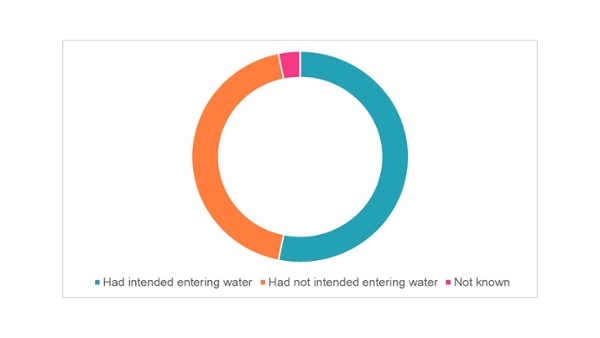
There were several different types of activity which were grouped into whether the child or young person intended to enter the water during the fatal incident. Activities where children and young people intended entering the water included water play, swimming, and bathing. Activities where the child or young person had not intended entering the water included incidents involving boats or other vehicles and falls into or near water. Almost half (27 out of 62, 44%) (fig. 6) of the children and young people had not intended entering the water during the fatal incident.
Fig 6. Proportion of non-intentional water-related fatalities in children and young people, Wales, 2013-22, by type of activity. (Produced by CDRP, using CDRP and WAID data).
Findings – place
Non-intentional water-related fatalities by location of incident and location of residence
Over half (33 out of 62, 53%) of the non-intentional water-related fatality incidents occurred in five local authority areas: Pembrokeshire (10), Gwynedd (seven), Conwy (six) Powys (five) and Vale of Glamorgan (five). There were fewer than five fatality incidents in each of the 17 other local authority areas in Wales.
Location of residence was only available for children under 18 years of age. Eight out of 26 children under 18 years of age (31%) were residents outside of Wales. The majority (94%) of the 18 Welsh resident children resided in the same local authority in which the incident occurred.
Non-intentional water-related fatalities by location type
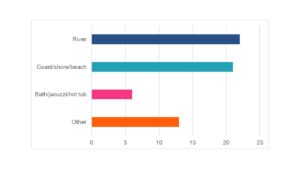
Over a third of the non-intentional water-related fatalities occurred in a river (22 out of 62), a third occurred at the coast, shore, or beach (21 out of 62), and one in 10 occurred in a bath, jacuzzi or hot-tub (six out of 62) (fig.2). Thirteen fatalities occurred in other locations, including ponds, lakes, reservoirs, quarries, docks, pools or at sea.
Fig 7. Count of non-intentional water-related fatalities in children and young people, Wales, 2013-22, by location type. (Produced by CDRP, using CDRP and WAID data).
Conclusions
There were 86 water-related fatalities in Wales in children and young people under 25 years of age between 2013 and 2022; 62 were non-intentional.
For the non-intentional fatalities, almost half (47%) of the fatalities occurred during June, July and August, and Sunday was the most common day of occurrence.
Seventy-nine percent of the children and young people were male.
Over half (58%) of the fatalities occurred in the 18-24 years age group, even though the proportion of young people in this age group accounted for less than one third of the population of children and young people aged 0-24 years of age, therefore this age group was over represented.
The presence of drugs or alcohol was noted in almost half (47%) of fatalities in the 18-24 years age group.
Almost half of the children and young people (44%) were taking part in activities where they had not intended entering the water when the fatal incident occurred.
A third of fatalities occurred in a river and a third occurred at the coast, shore, or beach and over half of the fatalities occurred in five out of 22 local authorities.
This information will be useful for water safety professionals to inform their prevention work in order to reduce the number of water-related fatalities in children and young people.
Report downloads
Water-related fatalities in children and young people under 25 years of age Wales 2013 to 2022
PDF, 568KB
Download PDF - Water-related fatalities in children and young people under 25 years of age Wales 2013 to 2022 (568 KB)
Download PDFRelated reports
-
Thematic review of deaths of children and young people through probable suicide 2013 to 2017 – Main report
Suicide is a tragic event that causes distress for many people. It can be particularly difficult to lose a child or young person through suicide. There is rarely a single […]
Published on: 1st December 2019
-
Thematic review of deaths of children and young people through probable suicide 2013 to 2017 – Summary
Deaths of children and young people through probable suicide 2013 to 2017, a summary.
Published on: 1st December 2019
-
Rapid review – deaths of children from dog bites/ strikes
Dogs are valued companions for many families. Early socialisation with children and others is important for family dogs. Although a rare cause of death, dog bites or strikes are an […]
Published on: 1st September 2014
-
Rapid response to child deaths from meningitis and meningococcal disease in Wales
It seeks to describe the numbers of cases known to the Child Death Review Programme and identify key guidance/recommendations in existence for the UK that could contribute to reducing child […]
Published on: 22nd October 2014
-
A thematic review of teenage motor vehicle deaths 2013
The CDR Programme is being re-established in Wales. The aim of the programme is to identify and describe patterns and causes of child death, including any trends, and to recommend […]
Published on: 2nd January 2013
-
Thematic review of deaths of children and young people through probable suicide 2006 to 2012
The Child Death Review Programme undertook this thematic review to examine factors that have contributed to suicide deaths, identify opportunities for prevention and make recommendations to reduce the risk of […]
Published on: 1st March 2014