

Meningitis and meningococcal epidemiology and sources of surveillance
Published on: 9th June 2025
- Surveillance
Epidemiology
Meningococcal disease
The majority of meningococcal infections occur in babies and children aged less than five years of age. There is a smaller, secondary peak in incidence in young adults.
Most cases of meningococcal disease occur sporadically, with less than 5% of cases occurring in clusters. Outbreaks of meningococcal disease are more common among teenagers and young adults, although still rare. These include outbreaks that have been clustered around schools and universities. Public health interventions may include vaccination (depending on serogroup) and chemoprophylaxis.
Meningococcal disease shows a seasonal pattern with a peak in winter. In the past 50 years, most meningococcal disease in the UK has been due to group B (MenB) and group C (MenC). The MenC vaccine introduced in 1999 has now successfully reduced cases to just a small number each year. Currently MenB accounts for the vast majority of meningococcal disease.
Meningococcal disease has a case fatality rate of approximately 5-10%
Meningitis caused by other organisms
The epidemiology of meningitis due to other organisms is more complex to ascertain. Cases of meningitis resulting from infection with measles virus, mumps virus or Haemophililus influeanzae B bacteria have decreased since the introduction of routine childhood vaccination against these diseases.
After meningococcal disease, invasive infection with the bacterium Streptococcus pneumoniae (also called the pneumococcus) is one of the most frequently reported causes of septicemia (blood poisoning) and meningitis.
The introduction of vaccination against several pneumococcus serotypes which are particularly associated with causing invasive disease is recommended for those aged over 65, individuals in a high-risk group for infection and for all children (as part of the routine childhood immunisation programme since 2006)
Table of contents:
- Sources of surveillance data for Wales
- Notification data
- Laboratory-confirmed meninogococcal disease
- Rates of meningitis and meningococcal disease in Wales
- Number of notifications of meningococcal septicaemia, total meningitis and specified type of meningitis in Wales: 1999-2024
- Number of notifications of meningococcal septicaemia, total meningitis and specified type of meningitis in Wales: 2015-2025
- Number of laboratory reports of Neisseria meningitidis by serogroup in Wales 2010-2025
- Number of laboratory reports of Neisseria meningitidis by serogroup in Wales 2010-2025
- Immunisation
- Links to other meningitis/meningococcal surveillance
- Related reports
- Related data
Sources of surveillance data for Wales
Notification data
It is a statutory requirement in the UK to notify all cases of clinically diagnosed meningitis, whether or not microbiologically confirmed. This statutory requirement for the notification of certain infectious diseases came into being in 1891 and includes all forms of meningitis (whatever the cause). All clinically diagnosed cases of meningococcal septicaemia must also be notified. Notifications in Wales are recorded in the all-Wales case and incident management system, known locally as Tarian.
Whenever possible, meningitis notifications are sub categorised i.e. meningococcal, pneumococcal, viral, other specified and unspecified. Type of meningitis can often only be determined once confirmed by a laboratory test and may remain unspecified until test results are available.
One of the main purposes of the notification system is to detect possible outbreaks and epidemics in a timely way. Accuracy of diagnosis is secondary and since 1968 clinical suspicion of a notifiable infection is all that is required. If a diagnosis of meningitis later proves incorrect it should be de-notified, therefore the number reported notifications can change over time.
Laboratory-confirmed meninogococcal disease
Laboratory-confirmed cases are cases where a sample, usually of blood or spinal fluid, is taken from a patient with symptoms and testing of the sample in a laboratory indicates the presence of meningococcal bacteria, or DNA from those bacteria. Further testing can establish which serogroup of meningococcal bacteria is responsible for disease.
However, every year there are a number of cases of meningococcal disease which are not confirmed in the laboratory. These are cases where the patient is diagnosed on the basis of symptoms of disease, but there is no confirmation from laboratory tests either because it is not possible to take a sample or treatment (which kills the organism) has started before a sample can be taken. Unconfirmed cases will not be counted in the
Rates of meningitis and meningococcal disease in Wales
Number of notifications of meningococcal septicaemia, total meningitis and specified type of meningitis in Wales: 1999-2024
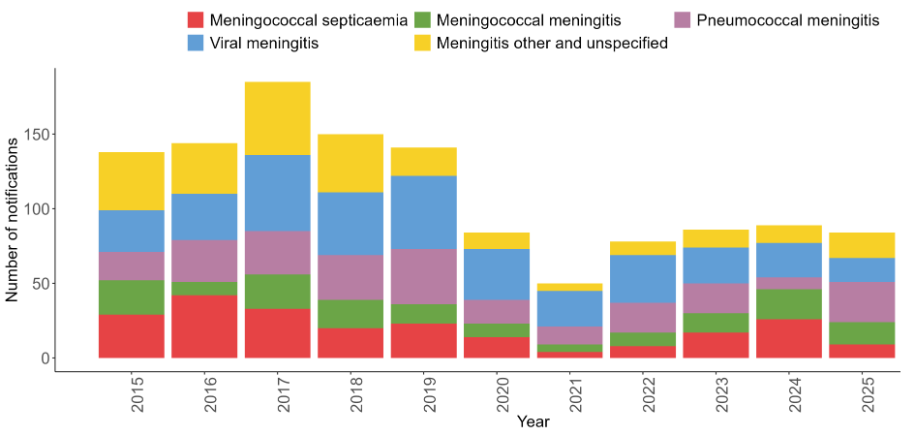
Source: Public Health Wales Tarian case and incident management system
Number of notifications of meningococcal septicaemia, total meningitis and specified type of meningitis in Wales: 2015-2025
| Year | Notifications of meningococcal septicaemia | Total notifications of meningitis | Meningococcal notifications of meningitis | Pneumococcal notifications of meningitis | Viral notifications of meningitis | Unspecified notifications of meningitis |
|---|---|---|---|---|---|---|
| 2015 | 29 | 138 | 23 | 19 | 28 | 39 |
| 2016 | 42 | 144 | 9 | 28 | 31 | 34 |
| 2017 | 33 | 185 | 23 | 29 | 51 | 49 |
| 2018 | 20 | 150 | 19 | 30 | 42 | 39 |
| 2019 | 23 | 141 | 13 | 37 | 49 | 19 |
| 2020 | 14 | 84 | 9 | 16 | 34 | 11 |
| 2021 | 4 | 50 | 5 | 12 | 24 | 5 |
| 2022 | 8 | 78 | 9 | 20 | 32 | 9 |
| 2023 | 17 | 86 | 13 | 20 | 24 | 12 |
| 2024 | 26 | 89 | 20 | 8 | 23 | 12 |
| 2025 | 9 | 84 | 15 | 27 | 16 | 17 |
Source: Public Health Wales Tarian case and incident management system
Number of laboratory reports of Neisseria meningitidis by serogroup in Wales 2010-2025
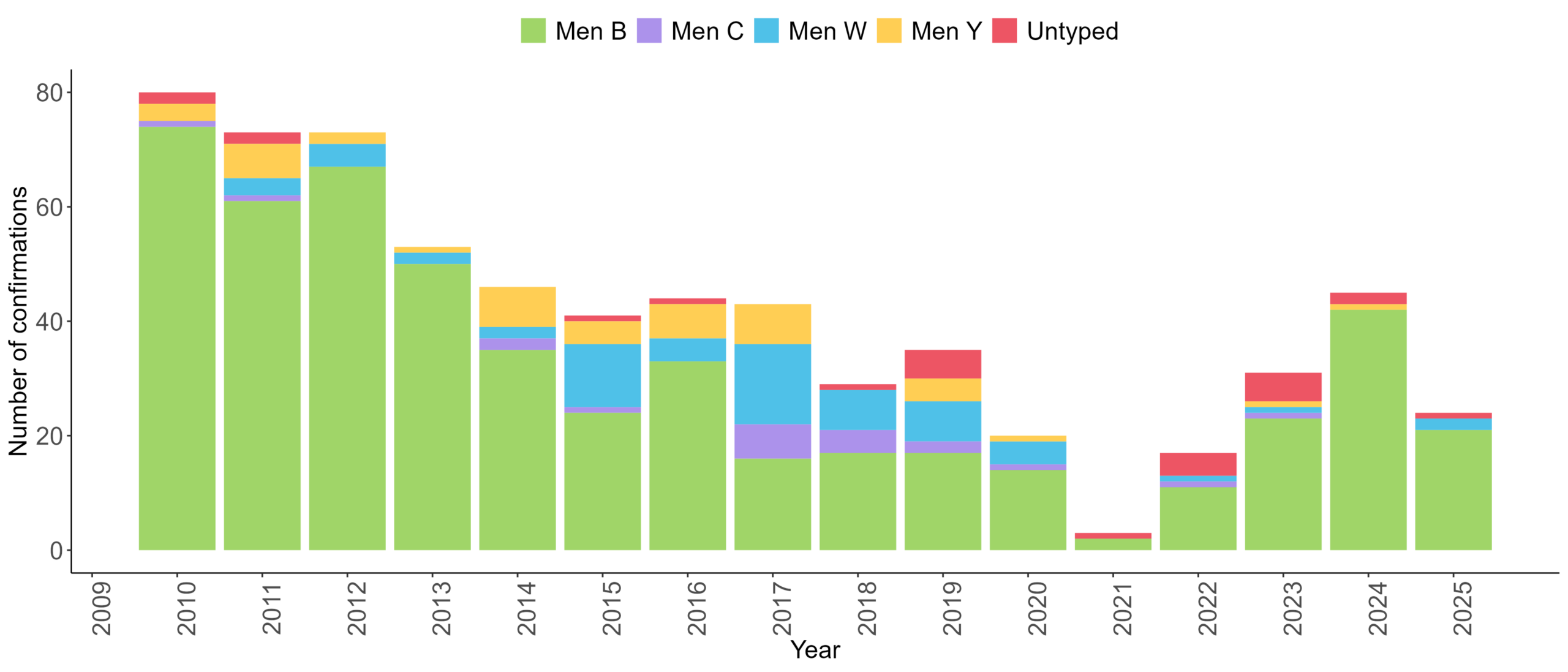
Source: UK Health Security Agency Meningococcal Reference Unit
Number of laboratory reports of Neisseria meningitidis by serogroup in Wales 2010-2025
| Year | Group B | Group C | Group W | Group Y | Not available | Total |
| 2010 | 74 | 1 | 0 | 3 | 2 | 80 |
| 2011 | 61 | 1 | 3 | 6 | 2 | 73 |
| 2012 | 67 | 0 | 4 | 2 | 0 | 73 |
| 2013 | 50 | 0 | 2 | 1 | 0 | 53 |
| 2014 | 35 | 2 | 2 | 7 | 0 | 46 |
| 2015 | 24 | 1 | 11 | 4 | 1 | 41 |
| 2016 | 33 | 0 | 4 | 6 | 1 | 44 |
| 2017 | 16 | 6 | 14 | 7 | 0 | 43 |
| 2018 | 17 | 4 | 7 | 0 | 1 | 29 |
| 2019 | 17 | 2 | 7 | 4 | 4 | 35 |
| 2020 | 14 | 1 | 4 | 1 | 0 | 20 |
| 2021 | 2 | 0 | 0 | 0 | 1 | 3 |
| 2022 | 11 | 1 | 1 | 0 | 4 | 17 |
| 2023 | 23 | 1 | 1 | 1 | 5 | 31 |
| 2024 | 42 | 0 | 0 | 1 | 2 | 45 |
| 2025 | 21 | 0 | 2 | 0 | 1 | 24 |
Source: UK Health Security Agency Meningococcal Reference Unit, Guidance for the public health management of meningococcal disease
Immunisation
Vaccines are available against certain types of bacterial meningitis and are given as part of the routine childhood and adolescent immunisation programme. These are meningococci groups B and A, C, W, Y, and pneumococcus and Haemophilus influenzae (HiB), which can also cause meningitis.
Additionally, vaccination against some other diseases, such as mumps and measles which can cause meningitis, is also part of the childhood immunisation schedule.
Uptake of routine childhood information is monitored and reported on a quarterly basis through the Wales COVER (Coverage of Vaccinations Evaluated Rapidly) Scheme. Quarterly and Annual reports are available here.
More information on vaccines against meningococcal disease is available below:
Links to other meningitis/meningococcal surveillance
- Public Health England
- Health Protection Scotland
- Health Protection Surveillance Centre (Ireland)
- Centers for Disease Control and Prevention (CDC)-USA
Related reports
-
Interventions to increase childhood vaccination: evidence map
Next update: January 2026 Contact for queries and feedback Introduction This map provides structured access to an up to date, high level, robust body of evidence on the broad topic […]
Published on: 31st January 2025
-
Rapid response on deaths of children from meningitis and meningococcal disease
Background This rapid response on deaths of children from meningitis and meningococcal disease in Wales is undertaken for, and at the request of, Welsh Government. It seeks to describe the […]
Published on: 1st October 2014