

Mental health crisis among children and young people in Wales
Authors: Annette Evans, Enfys Preece
Recorded inequalities and contact with services before crisis, 2016 to 2021.
Key messages
- We followed 626,204 children and young people aged 11 to 24 years who were registered with a Welsh GP.
- Between 2016 and 2021, 20,849 had a new mental health crisis recorded in the NHS data used for this study.
- Recorded crisis rates were higher among females, children and young people living in more deprived areas, and those living in urban areas or rural towns.
- There was no single route into crisis. Some children and young people had several earlier contacts with services, while others had little recent contact recorded.
- Earlier contact can create opportunities to offer help, but low recorded contact may not mean that a young person had no needs or received no support elsewhere.
Rationale / why this matters
Mental health and well-being can change as children and young people grow, move through education, form relationships and become more independent. Most young people will not experience a mental health crisis. However, when a crisis does happen, it can have serious and lasting effects on the young person, their family and requires specialist services and care. A crisis may lead to urgent help from an ambulance service, an emergency department, an urgent outpatient service or a hospital admission.
There is growing interest in preventing needs from escalating to the point of mental health crisis. To do that well, we need to understand two connected issues. First, crisis is not experienced equally across the population. Social and economic circumstances, access to support, age, sex and other factors may influence who reaches urgent or emergency care. Second, children and young people do not all follow the same route before crisis. Some have repeated contact with health or care services, while others have little recent contact visible in routine records.
Looking at inequalities and previous touchpoints together gives a fuller picture. It helps show which groups are more often represented in recorded crisis, where earlier contact may create an opportunity to offer support, and where services may need to reach beyond traditional healthcare settings. It also helps avoid a simple but misleading assumption that every crisis follows a clear or predictable pathway.
This work supports Welsh Government and Public Health Wales priorities to improve mental health to make help easier to access for children and young people. It aligns with priorities on mental health and wellbeing, suicide and self-harm and a whole-system approach, including schools, alongside timely, joined-up help through a ‘no wrong door’ approach and NEST. It also supports the Public Health Wales strategic priority to promote better mental health, particularly for children and young people.
A young person with a mental health issue may first speak to a parent, teacher, school counsellor, GP, voluntary organisation, helpline or emergency service. The most useful response will depend on their circumstances and level of need. These findings therefore should be considered within the entire system of support, rather than from one service alone.
What we did
We carried out a population-based study of children and young people aged 11 to 24 years who were registered with a GP in Wales. The study covered 2016 to 2021. Records from different services were linked using anonymised data, so researchers could study contacts relating to the same person without seeing names, addresses or other information that could directly identify them.
We first identified new mental health crisis events recorded in urgent or emergency NHS care. We then described how often these events happened and how patterns differed by age and sex. We looked at simple rates of number of new crisis events before extra adjustments across different groups, including deprivation, ethnicity and whether someone lived in an urban or rural area. The data came from hospital and service records, so they cannot show every part of inequality or lived experience.
Next, we looked backwards from the date of crisis to understand previous touchpoints with services. These included inpatient care, emergency departments, ambulance services, outpatient appointments and GP records. Where data were available, we also considered social care, substance misuse services and education-related characteristics. For each young person with a new recorded crisis, we selected six young people of a similar age who had been followed for a similar period but did not have a new crisis recorded. We then compared their previous contacts with health and care services.
Finally, we grouped people whose records looked similar in some ways. This helped us look for broad patterns before crisis. This part of the work was exploratory, which means it was used to look for patterns rather than prove causes. The groups are not diagnoses, service categories or fixed “types” of young person. They are a way of summarising patterns that appeared more often together in the available data. The analysis used a technique called cluster analysis, a type of machine learning, with 50 variables; for further details see the methodology documentation.
About the data
The study used anonymised information held in the SAIL Databank. Records covered urgent outpatient care, ambulance incidents, emergency department attendances, hospital admissions and deaths. Other linked information included general practice, social care, substance misuse services and education data where available. All analysis took place in a secure research environment under the required approvals.
What do we mean by a ‘new recorded mental health crisis’?
For this study, a mental health crisis was identified when a young person used an urgent or emergency NHS service for a mental health-related reason. This included recorded self-harm, suicidal behaviour, psychosis, serious eating disorders and other severe mental health needs. Services used on the same or following day were treated as part of the same event.
The word “new” has a specific meaning here. It means there was no mental health crisis recorded in the available data during the previous 12 months. It does not prove that this was the young person’s first experience of crisis, their first mental health difficulty, or their first attempt to seek help. An earlier crisis may have happened more than a year before, may have been supported outside the datasets, or may not have been recorded in a way the study could identify.
What routine data can and cannot tell us
Information collected when people use services is useful because it allows us to study a large population and include events that are uncommon at an individual level. Linking records can show contacts across several parts of the NHS and other public services. This provides a broader system view than relying on one service or a small survey.
However, these records were created to provide and manage services, not primarily for research. Coding and data entry can vary between services and over time. Some information may be incomplete, delayed or entered under a different main reason for care. A mental health problem may be present but not recorded by the clinician or healthcare worker because it is in addition to the main reason for care in the data used by this study.
This study also does not capture every place where children and young people receive help. Support from family and friends, schools, youth services, community groups, voluntary organisations, private providers are not included in this study. Some services outside Wales may not appear in this data and contacts with highly specialist mental health services may be incomplete from Child and Adolescent Mental Health Services (CAMHS). For these reasons, having little recorded contact does not mean that a child or young person had no needs, sought no help or received no support.
What we found
How many children and young people had a recorded crisis?
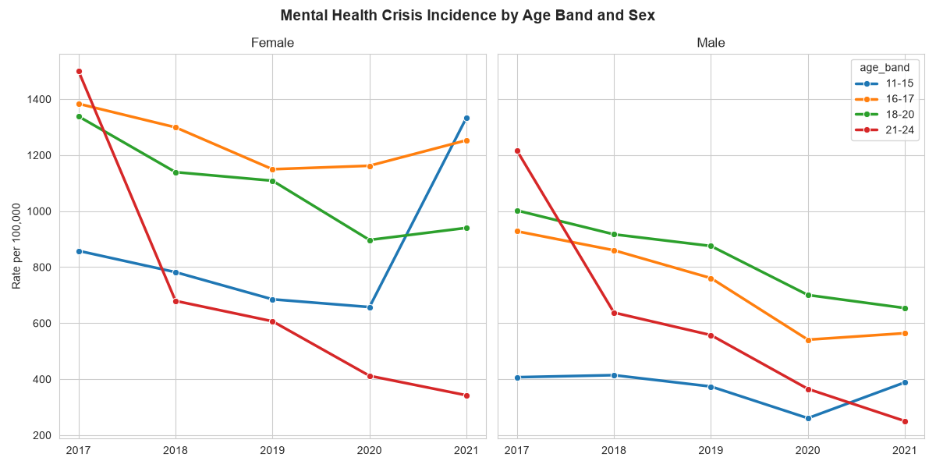
Among 626,204 children and young people in the cohort, 20,849 had a new mental health crisis recorded between 2016 and 2021. Recorded crisis events increased by age through adolescence and remained high in early adulthood.
This is a substantial number of children and young people, even though a recorded new crisis was uncommon across the cohort as a whole. The pattern by age suggests that needs and the response of services to crisis change across adolescence and the transition into adulthood. Higher recorded numbers for a particular service do not necessarily mean that every difference reflects underlying mental health alone; help-seeking, referral routes, access and recording can also affect who appears in the data.
At most ages, simple recorded rates before extra adjustments were higher among females than males (Figure 1). This may reflect differences in mental health experiences, the way distress is expressed, willingness or ability to seek help, recognising that help is needed, contact with services, and how concerns are recorded. The study describes the patterns but cannot determine how much each explanation contributes to these patterns.
Crisis was not equally recorded across groups
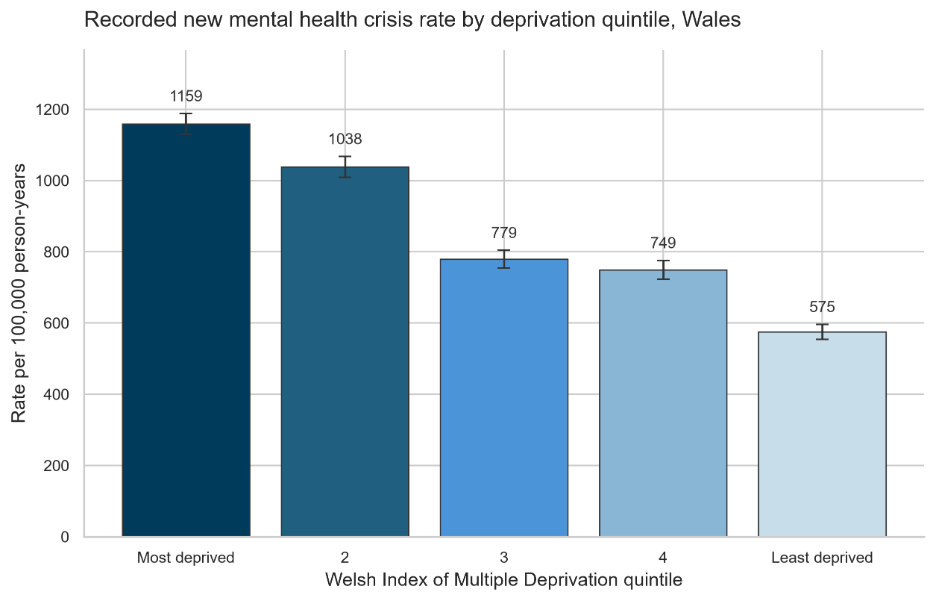
The results showed clear differences between groups, but they need careful interpretation. We looked at whether crisis records differed by sex, deprivation, ethnicity and whether someone lived in an urban or rural area. We also considered how these factors might work together. However, most recorded cases were in urban areas, and some ethnic groups had small numbers in the data. This limited what could be said reliably about combined characteristics. Area deprivation was the clearest and most consistent inequality measure available, so it is the main focus here. Recorded crisis rates were higher among females and among children and young people living in more deprived areas (Table 1). This means the figures show patterns in service records, not the full picture of need in every community.
Looking across the whole population, the estimated five-year risk of a recorded mental health crisis was generally between 1% and 3%, depending on the combination of factors considered. Overall, risk was higher for females than males, and was also higher among children and young people living in more deprived or urban areas.
Area deprivation describes the wider conditions in the neighbourhood where a child or young person lives. It does not describe every household or individual. These wider conditions can include income, housing, transport, safe places to spend time and local support. The findings do not show that deprivation directly caused an individual crisis, but they do show that children and young people in more deprived communities were more often presenting to services with a new crisis in the records (Figure 2).
Deprivation means an area may have fewer resources, such as money, good housing, transport, services or safe places to spend time. Urban areas are towns and cities. Rural areas are smaller towns, villages or countryside areas.
Ethnicity and whether someone lived in an urban or rural area need careful interpretation. Some groups had relatively few recorded crisis events, which makes the results less certain. Missing or general descriptions for ethnic groups may also hide important differences. The results should therefore describe broad patterns and avoid presenting small groups as if they can be ranked precisely.
| Characteristic | With recorded crisis (n) | With recorded crisis (%) | Without recorded crisis (n) | Without recorded crisis (%) |
|---|---|---|---|---|
| Total | 20,849 | 605,355 | ||
| Sex | ||||
| Male | 8,639 | 41.4% | 308,447 | 51.0% |
| Female | 12,210 | 58.6% | 296,908 | 49.0% |
| WIMD | ||||
| 1 Most deprived | 6,225 | 29.9% | 131,986 | 21.8% |
| 2 | 4,883 | 23.4% | 113,993 | 18.8% |
| 3 | 3,812 | 18.3% | 130,271 | 21.5% |
| 4 | 3,101 | 14.9% | 102,976 | 17.0% |
| 5 Least deprived | 2,797 | 13.4% | 126,129 | 20.8% |
| Rurality | ||||
| Urban | 15,599 | 74.8% | 454,110 | 75.0% |
| Rural town | 3,511 | 16.8% | 87,912 | 14.5% |
| Rural village | 1,739 | 8.3% | 63,330 | 10.5% |
| Ethnicity | ||||
| White | 19,661 | 94.3% | 530,010 | 87.5% |
| Asian | 180 | 0.9% | 19,788 | 3.3% |
| Mixed | 286 | 1.4% | 11,686 | 1.9% |
| Other | 410 | 2.0% | 22,897 | 3.8% |
| Missing | 312 | 1.5% | 20,971 | 3.5% |
Table summary: This table compares children and young people in the study cohort with a new recorded mental health crisis to children and young people without a recorded crisis. It shows numbers and percentages by sex, area deprivation, rurality and ethnicity. Children and young people with a recorded crisis were more often female than those without a recorded crisis, with females making up 58.6% of those with a recorded crisis and 49.0% of those without a recorded crisis. Children and young people with a recorded crisis were also more likely to live in the most deprived areas, with 29.9% in the most deprived deprivation group compared with 21.8% of those without a recorded crisis. Most children and young people in both groups lived in urban areas, at around 75%. Ethnicity findings should be interpreted with caution because ethnicity recording was incomplete and some groups had small numbers of recorded crisis events. Missing or broad ethnicity information may hide important differences between children and young people. Although the full cohort contributed information to the analysis, the small number of crisis events in some ethnic groups means the results are less certain. For this reason, ethnicity results can only be read as broad patterns in the available records, rather than precise comparisons between groups.
What happened during the recorded crisis?
Recorded crisis events involved urgent or emergency NHS care. Some children and young people received care through one service, while others had contact with more than one service. The services included ambulance, emergency department, urgent outpatient care, day case psychiatric assessment or treatment, and inpatient stays lasting more than one day. Separating day case care from longer inpatient stays helps distinguish short psychiatric assessment or treatment from admissions lasting more than one day.
Around four in five recorded crisis events involved one NHS service, while the remainder involved two or more. This shows where children and young people present to services and their pathway so does not show whether the care was timely or appropriate. It does highlight the need for clear communication when a young person moves between services (Figure 3).
Routes into urgent and emergency care for recorded new mental health crisis
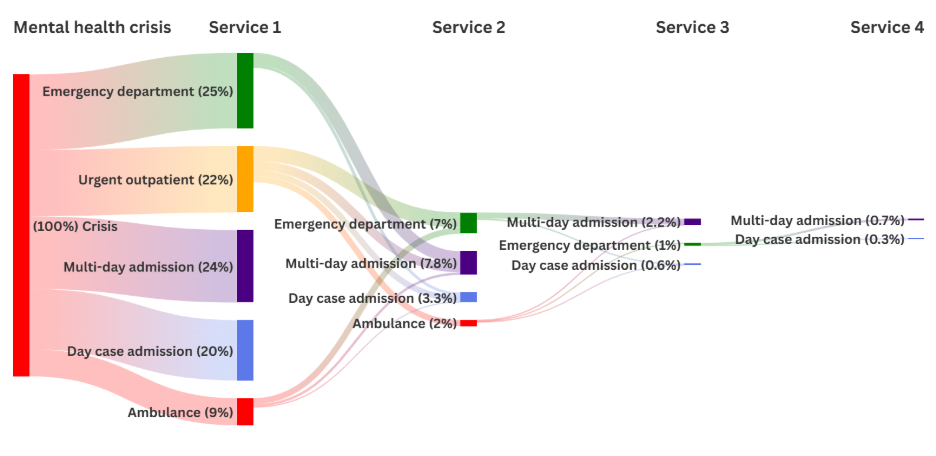
Some children and young people were admitted to hospital for day case psychiatric assessment or treatment, more often when they were of a younger age. Whilst others stayed in hospital for more than one day. For some admissions, mental health was recorded as the main reason for care. In others, a mental health crisis was recorded alongside another main reason for admission including injury or other illness. The latter highlights the importance of mental health support across general hospital patients as well as mental health specialist settings.
What happened before crisis?
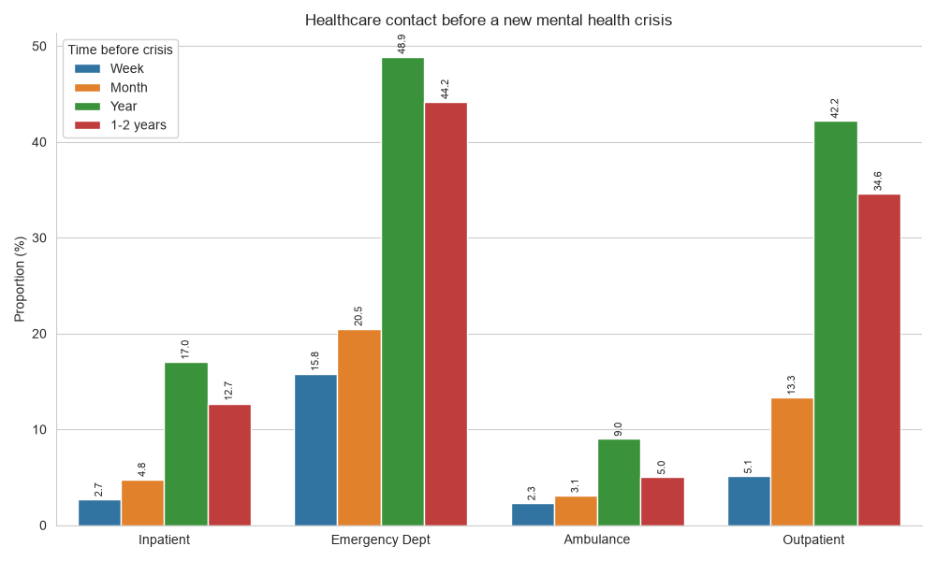
Some children and young people had contact with health services shortly before crisis. More than 15% had a non-crisis health-service contact in the previous week and more than 20% had contact in the previous month. In the previous year, nearly half had attended an emergency department, compared with about one in five similar children and young people without a recorded crisis. Contact was also higher across other healthcare settings that were compared in this study.
The timing and setting of contact matter. Contact in the days or weeks before crisis may offer a chance to notice a change, ask about mental well-being, share information about support or arrange follow-up. Contact over a longer period may show a broader pattern of health need or repeated service use. However, routine data does not tell us whether mental health was discussed, whether staff knew a crisis was developing, or whether a different action could have prevented it.
Emergency department contact stood out, showing large differences between groups. Nearly 50% of those with a new recorded crisis had attended an emergency department during the previous year, compared with about 20% of matched children and young people without a recorded crisis (Figure 4). Repeat emergency attendance was also more common before a crisis event. These contacts were not recorded as mental health crisis events. However, some of these contacts may have been related to mental health and they identify a group already visible to urgent care.
Recorded GP mental health history was present for a minority of those with a new crisis event (Figure 5). In the year before a new crisis, around 10% had a GP record relating to anxiety and around 25% had a record relating to depression, including relevant diagnoses, symptoms or prescriptions. These figures were higher than among matched children and young people without a recorded crisis, but they also show that GP mental health records alone would not identify everyone who later appeared in crisis data.
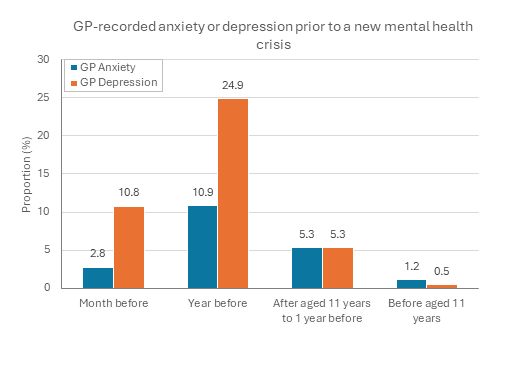
Children and young people with a recorded crisis also had higher levels of some wider signs of vulnerability. Compared with matched children and young people without a recorded crisis, larger proportions had contact with social services or substance misuse services, were recorded as neurodivergent, were eligible for free school meals or had special educational needs. Education data had a small amount of missing information, and these characteristics should not be treated as causes of crisis. They point instead to the importance of seeing mental health alongside the wider circumstances of children and young people’s lives.
There was no single pathway
The analysis identified seven broad patterns of service use among the 20,849 children and young people before a recorded new crisis (Figure 6). The two largest groups, making up nearly two-thirds of all cases, had lower recorded health-service contact beforehand. Around one in five were in groups with higher emergency or inpatient contact ahead of their crisis. Smaller groups had more social care or substance misuse contact, gaps in GP records, or previous GP-recorded mental health contact.
The two largest groups that accounted for 64% of recorded crisis cases had comparatively lower recent emergency-service contact, although one was more often treated through emergency departments at the crisis event and the other through inpatient care. Their lower recorded contact does not mean that the children and young people had no previous difficulties. It means that the linked health and care services included in this study contained fewer recent touchpoints.
Other groups had clearer signs of contact or complexity. Some had higher emergency or inpatient use before crisis. Some had more contact with social care or substance misuse services. One group had less continuity in GP records, and another showed more previous GP-recorded mental health contact. The smallest groups were still made up of hundreds of young people, but their patterns should be treated as prompts for further investigation rather than precise service use categories. These small groups also reflect that social care and substance misuse services are used by a minority of children and young people in the population.
These profiles describe broad patterns in the data rather than fixed types of children and young people. A profile is a group of people whose records looked similar in some ways when comparing groups, but a type of service use does not only occur in a particular group.
Taken together, the pathways show why prevention cannot rely on a single trigger or dataset. It shows one in five children and young people have contact with services before a new mental health crisis. However, a system focused only on frequent service users would miss many children and young people with little recorded contact. A system focused only on first presentation would miss opportunities among those already attending emergency, inpatient, outpatient or other services. Therefore, pathways require different ways of recognising need and offering support.
Profiles of recorded service use before new mental health crisis
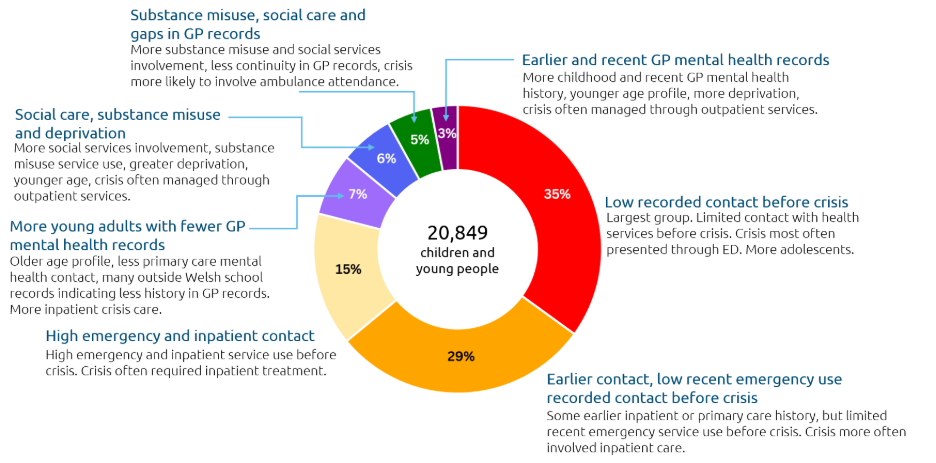
This diagram summarises seven service-use profiles identified among children and young people with a new recorded mental health crisis. It shows the number and percentage of children and young people in each profile, a short plain-English label, and the main characteristics of previous service contact and route into crisis care. The two largest profiles were children and young people with little recent recorded healthcare contact before crisis, together accounting for 64% of recorded crisis cases. Some profiles more often involved urgent outpatient care at the crisis event. This may reflect different routes into urgent support, but the routine data do not show whether this was a first ever presentation for crisis, what treatment was offered, or whether medication was used.
Cluster 1 was the largest group, with 7,397 (35%) people, followed by cluster 2 with 6,147 (29%) , cluster 3 with 3,106 (15%), cluster 4 with 1,404 (7%), cluster 5 with 1,235 (6%), cluster 6 with 981 (5%), and cluster 7 with 579 (3%). Short plain-English labels for clusters 1 to 7 respectively were: low recorded contact before crisis; earlier contact, low recent emergency use recorded contact before crisis; high emergency and inpatient contact; more young adults with fewer GP mental health records; social care, substance misuse and deprivation; substance misuse, social care and gaps in GP records; earlier and recent GP mental health records.
Why this matters
The findings show that crisis was recorded unequally and that children and young people reached urgent or emergency care through different routes. Higher rates in more deprived communities is an important finding because services should be available according to need and should not create extra barriers for those already facing social or economic pressures. Inequality may arise before, during or after a crisis through differences in exposure to adversity, access to support, recognition of need, service availability and follow-up.
Earlier touchpoints matter because they show where children and young people are already visible to services (Figure 4). Every contact is not automatically a missed opportunity: staff may have had no reason to suspect an approaching crisis, and the contact may have concerned an unrelated problem. Nevertheless, repeated or changing patterns of contact can support sensitive enquiry, better information sharing and timely follow-up when warning signs are present.
The lower-contact pathways are equally important. They suggest that NHS records alone cannot provide a complete early-warning system. Prevention also depends on support in schools, families, communities, youth services and voluntary organisations, alongside clear routes into healthcare when clinical help is needed. Young people should not have to understand a complex service system before they can ask for help.
The study cannot tell us what an individual young person needed, whether the response they received was appropriate, or whether a crisis could have been prevented. Its value is in showing the bigger picture across the population. It shows broad inequalities, identifies settings where contact often happened, and highlights the need for more than one route to earlier support.
Implications for policy and practice
The findings support action across the wider system rather than a single new intervention. Priorities should be developed with young people, families, practitioners and communities, and should be tested to ensure they improve access without widening inequalities.
- Make it easier for young people and families to recognise when help is needed and where to find it.
- Improve access to early support in primary care, schools, community services and voluntary organisations, and timely access to specialist mental health services.
- Prioritise equitable access and follow-up in more deprived communities, where recorded crisis rates were higher.
- Use emergency department, ambulance, inpatient and outpatient contacts as opportunities for sensitive enquiry, signposting and follow-up.
- Strengthen communication between primary care, emergency care, community support and specialist services in patient pathways.
- Design services with young people, including those with complex needs or limited continuity in their records.
- Interpret ethnicity and rurality findings cautiously and improve data completeness so inequalities can be assessed more reliably.
Make access understandable and straightforward
Young people and families need clear information about what support is available, when to seek urgent help and what to expect after making contact. Routes should be easy to navigate across local areas and should not depend on knowing which service owns a particular problem. Information should be accessible to young people with different communication needs and should be available through the places they already use.
Act on inequality
Higher recorded rates in deprived communities should be reflected in planning, outreach and evaluation. This may include considering transport, appointment flexibility, digital exclusion, service location and the ability of families to navigate several agencies. Monitoring should look not only at overall use, but also at who reaches support, who waits, who disengages and who returns in crisis.
Use touchpoints carefully
Emergency departments, ambulance services, inpatient wards, outpatient clinics and general practice all see young people who may later appear in crisis records. Proportionate approaches could include sensitive questions where concerns are present, clear signposting, safety planning, communication with the young person’s usual care team and reliable follow-up. Any approach must respect privacy, consent, clinical judgement, and the fact that many contacts will not relate to mental health.
Connect services without making support feel clinical
Better links are needed between primary care, schools, community and voluntary support, emergency care, and specialist mental health services. Joined-up working should not mean that every difficulty is referred to specialist care. It should mean that young people receive a response suited to their needs, that important information is not lost between services, and that responsibility for follow-up is clear.
Improve the evidence
Better and more complete information on ethnicity, urban and rural areas, and service contact would make it easier to understand inequalities. Future work should include young people’s experiences, because records cannot show whether help felt timely, appropriate or easy to access. It should also examine contacts with schools, counselling, community and voluntary services where suitable data and governance arrangements exist.
If you need help now
This report describes research findings and does not provide individual medical advice.
If you need urgent mental health support for yourself or someone else, call NHS 111 Wales and select option 2. The service is free, available 24 hours a day, seven days a week, and is open to people of all ages. Calls are welcomed in Welsh. More information is available from NHS 111 press 2 service.
Online support is also available through SilverCloud, a confidential internet-based therapeutic and psycho-education programme.
If someone is in immediate danger or needs emergency medical help, call 999 or go to the nearest emergency department.
If you already have a crisis contact number or care plan, follow the instructions in that plan.
Acknowledgements
This report was written by Annette Evans and Enfys Preece, with support from colleagues in Public Health Wales.
We thank Annette and Enfys for their authorship, insight, and contribution to this work. We also thank Emily van de Venter for her valued insights, and colleagues from NHS Performance and Improvement for their helpful input.