

Mental health difficulties and mental well-being in young people in Wales
Key messages
- Mental health difficulties and mental well-being are related, but they are not the same thing.
- Clear definitions matter because they shape identification, support, monitoring, and policy decisions for young people.
- Key influences (e.g., sleep, bullying, academic pressure, and family/peer/teacher support) can affect mental health and well-being in different ways.
- Some young people with low well-being may not present with diagnosable difficulties, meaning needs can remain hidden from services.
- Measuring both difficulties and well-being provides a fuller picture to guide prevention and support for children and young people in Wales.
Table of contents:
Rationale – why is this important?
Supporting children and young people’s mental health and well-being is a strategic priority in Wales, reflected in national commitments to a whole-system approach, prevention, early intervention and improved access to support, including the Mental Health and Wellbeing Strategy, the NEST/NYTH Framework and the Whole-school Approach to Emotional and Mental Well-being. The 2026 Public Health Wales health needs assessment describes increasing emotional difficulties among children and young people and highlights the complex range of individual, social and wider environmental factors that may shape mental health and well-being. It calls for coordinated action across health, education and wider public services.
The terms ‘mental health’ and ‘mental well-being’ are often used interchangeably, but they describe related and distinct aspects of young people’s lives (see Figure 1). Being clear about the relationship between mental health difficulties and mental well-being, and how both present among children and young people in Wales, matters because it shapes how need is identified, how support is offered, and how progress is monitored (World Health Organization, 2021).
This work brings together national school survey data and linked routine health record analyses to examine how mental health difficulties and mental well-being relate to one another, which factors are associated with both, and whether some young people with high psychosocial need may be less visible in routine NHS data.
Understanding where mental health difficulties and mental well-being overlap, and where they do not, can help schools, families, services and policymakers respond more effectively.
The findings can inform prevention, early identification, school-based support, service planning and policy decisions for children and young people in Wales.
What did we do?
This work addressed three questions:
- How do mental health difficulties and mental well-being relate to one another among young people in Wales?
- Which social, emotional and behavioural factors are associated with mental health difficulties and mental well-being?
- Among young people with high psychosocial need, how many are not visible in routine NHS service data, and what factors are associated with this potential unmet need?
To answer these questions, we used national data from the School Health Research Network (SHRN) Student Health and Wellbeing Survey. For the linked data analysis, we linked SHRN survey responses to anonymised routine NHS records accessed securely through the SAIL Trusted Research Environment.
Key concepts
The diagram below shows the way people often think about the relationship between mental health difficulties and mental well-being: as two separate but connected dimensions. This is sometimes described as a dual-continuum approach. Some people view mental health difficulties and mental well-being as opposite ends of a single continuum, while others, including the World Health Organisation, define well-being more broadly. Research suggests they are separate but connected, and that both matter for understanding young people’s lives.
Young people’s mental and emotional health is shaped by interacting social, psychological and biological influences. Support should therefore combine action on wider determinants and protective factors, early relational and school-based support, and timely access to appropriate clinical care when needed.
- Mental health difficulties include challenges such as anxiety, low mood, behavioural problems, attention or hyperactivity issues, and peer difficulties. In this work, these difficulties are measured using the Strengths and Difficulties Questionnaire, which captures emotional, behavioural, attention/hyperactivity and peer-related difficulties rather than clinical diagnoses.
- Mental well-being reflects feeling connected, valued, hopeful, and able to cope with day-to-day pressures.
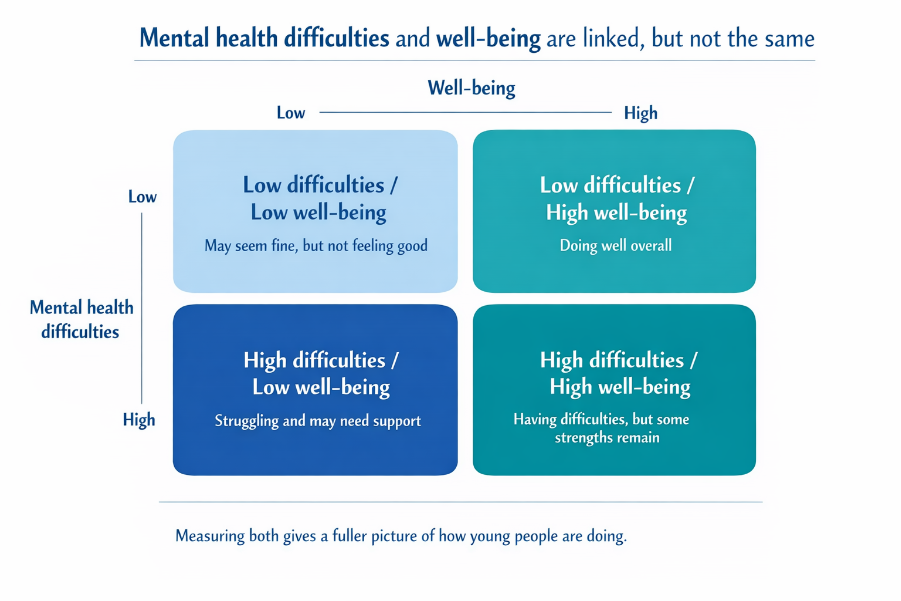
Understanding young people’s mental health and well-being in Wales
Young people in Wales face a range of pressures that can affect both their mental health and their well-being. Understanding where these overlap (and where they do not) helps schools, families, services and policymakers respond more effectively.
A young person may experience mental health difficulties while still having positive well-being through, for example, strong friendships or confidence at school. Conversely, someone with no diagnosable condition may still feel lonely, stressed or low in well-being. Because these concepts are often blended together, schools, families and services can struggle to see the full picture and respond appropriately. Supporting well-being through stronger relationships, better sleep and a greater sense of belonging may also help to reduce the risk or impact of mental health difficulties.
About the data used in this work
The findings on this page are based on data from the School Health Research Network (SHRN) Student Health and Wellbeing Survey. SHRN is a national programme that supports almost all maintained secondary schools in Wales to take part in a regular, anonymous survey of pupils’ health and wellbeing.
The survey is completed by pupils aged 11–16 years (Years 7 to 11) during the school day. Pupils complete the questionnaire privately online, choosing to respond in English or Welsh. The survey asks about many aspects of young people’s lives, including mental wellbeing, emotional and behavioural difficulties, sleep, friendships, bullying, school experiences and health behaviours.
Because SHRN reaches such a large and diverse group of pupils across Wales, it provides a robust picture of population‑level patterns in young people’s mental health and wellbeing. It is designed to help understand trends and inequalities across Wales, rather than to diagnose or assess individual pupils.
In the 2019/20 survey, around 119,000 pupils from 198 secondary schools took part (around 77% of eligible schools).
In the 2021/22 survey, around 123,000 pupils from 202 schools took part (around 75% of eligible schools).
To understand differences between what young people report about their mental health and well-being and their recorded contact with health services, we used a privacy-protecting research environment to link survey responses with anonymised NHS health records. This was possible only for pupils who consented to linkage with NHS records. No identifiable information is available to PHW; results are reported in summary form to explore differences between population groups.
Understanding the relationship between mental health difficulties and well-being
Mental health difficulties and mental well-being are related, but not the same (Suldo & Shaffer, 2008; Westerhof & Keyes, 2010). A young person may experience difficulties while still having some positive well-being, or have low well-being without elevated difficulties. We examined this relationship among young people in Wales using national population-level school survey data to determine whether measuring both provides a fuller picture of population need.
What did we find?
What we wanted to find out
We tested whether well-being decreases in a steady, dose–response pattern as mental health difficulties increase, and whether this differs by difficulty type (emotional, behavioural, attention/hyperactivity, and peer problems).
Data and measures
We used SHRN survey data from over 190,000 young people aged 11–16 in Wales. Participants completed the Strengths and Difficulties Questionnaire (SDQ) (Goodman, 1997; Goodman et al., 1998) and the Short Warwick–Edinburgh Mental Well-being Scale (SWEMWBS) (Stewart-Brown et al., 2009; Ng Fat et al., 2017).
What we did
We looked at average well-being scores across mental health difficulties categories, and then checked whether the pattern remained after accounting for age, sex, sleep, academic pressure, bullying, perceived support, and deprivation.
What we found
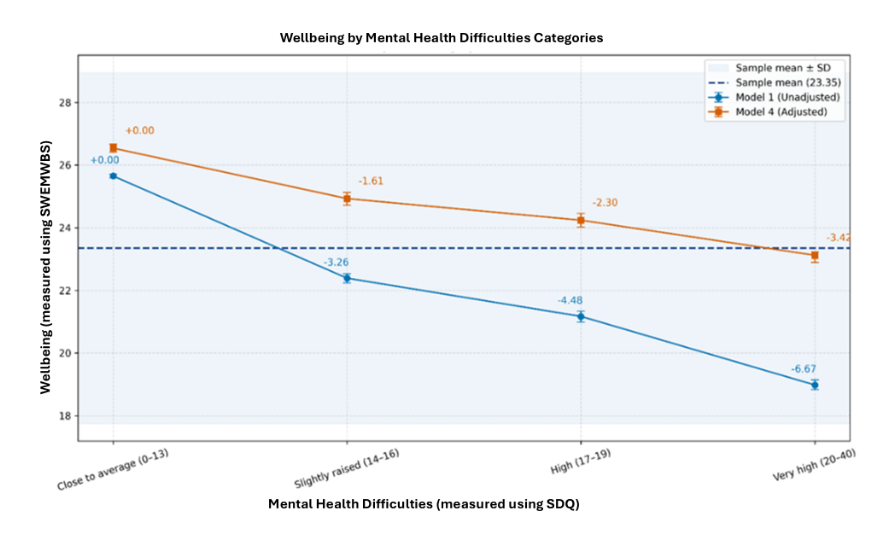
As shown in figure 2, we found that
- As mental health difficulties increased, well-being decreased in a clear, graded pattern
- This held across the full spectrum of difficulties — from slightly raised to very high.
- Young people with the highest emotional difficulties showed the lowest well-being overall.
- Behavioural and attention-related difficulties showed similar patterns, although the relationship was slightly less strong.
What this means
Together, these results show why it is important to measure both mental health difficulties and well-being. Symptoms capture distress and emerging problems, while well-being captures strengths and functioning; one cannot be inferred reliably from the other. Emotional symptoms showed the strongest link with low well-being, highlighting a potential early indicator for timely support.
Wider evidence indicates that increases in identified need have been particularly marked for emotional difficulties, including anxiety and depression, rather than occurring uniformly across every type or level of mental health difficulty (Public Health Wales, 2025; Public Health Wales, 2026). Separately, the prominence of academic pressure in this work is consistent with recent longitudinal evidence linking higher academic pressure in adolescence with subsequent depressive symptoms and self-harm (Guo et al., 2026). However, the findings presented here are observational and should not be interpreted as proving causation.
If difficulties and well-being are closely linked but not interchangeable, the next question is whether both are shaped by the same experiences. Read about the factors associated with mental health difficulties and well-being.
Study 2: Factors associated with mental health difficulties and well-being
Using national data from multiple years of the school health surveys, including more than 175,000 young people in Wales, we examined social, emotional and behavioural factors linked to both:
- mental health difficulties (SDQ)
- mental well-being (SWEMWBS)
What we wanted to understand
Young people’s lives are shaped by many experiences — including sleep, friendships, school pressure, bullying, family relationships, body image, and physical activity.
What we did not yet know was:
- Which factors matter most
- Whether the same factors affect difficulties and well-being in similar ways
- Whether some influences are specific to one and not the other
Understanding this helps schools, families and services focus on the areas that can make the biggest difference.
What the study found
Several modifiable factors were associated with both higher mental health difficulties and lower mental well-being. These included sleep difficulties, academic pressure, bullying and peer problems, negative body image, and lower perceived support from teachers or friends.
Supportive relationships appeared to be protective, with higher perceived support from teachers, friends and family associated with fewer mental health difficulties and higher mental well-being.
Figure 3 shows the factors most strongly associated with both outcomes. These factors emerged as the most consistent associations across both measures in the overall population-level analysis.
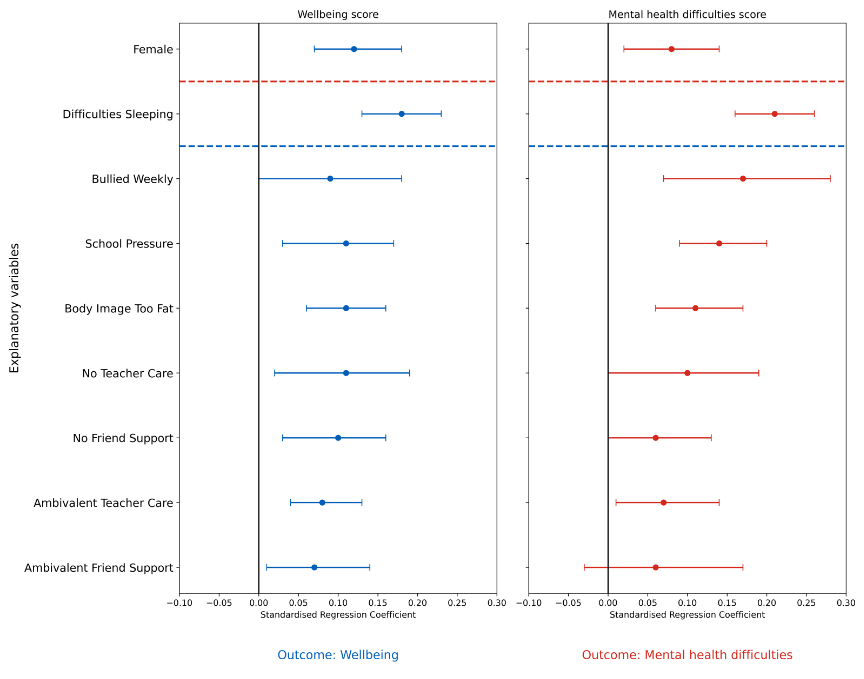
Sleep was the most important factor
Sleep difficulties showed one of the strongest associations with both:
- Higher mental health difficulties
- Lower well-being
Among all factors examined, sleep had one of the broadest and most substantial impacts.
Gender differences
Consistent with patterns across the UK (Office for National Statistics, 2018) and internationally, girls were more likely to report:
- Higher mental health difficulties
- Lower well-being
These differences underscore the importance of gender-sensitive approaches to support. Descriptive patterns also suggested poorer well-being and higher difficulties among young people who identified as non-binary, although these differences were not statistically significant in this analysis and should therefore be interpreted cautiously. Wider evidence indicates that experiences such as bullying and social exclusion may contribute to poorer mental health and well-being among trans, non-binary and gender-questioning young people, reinforcing the need for inclusive approaches.
The same broad pattern of associations was seen after accounting for demographic and social factors, including age, sex and deprivation. This suggests that sleep difficulties, academic pressure, bullying and peer problems, body image, and perceived support are important influences across the wider population of young people in Wales, rather than being limited to one demographic group. However, the strength of these associations may vary between groups and should be explored further where detailed subgroup analyses are available.
Why this matters
The evidence shows that while mental health difficulties and well-being share important influences, such as sleep, relationships, and stress, they are distinct concepts. Well-being is not simply defined by the absence of symptoms.
- Schools can focus on common risk factors to enhance both mental health and well-being.
- Families gain insight into how sleep, pressure, and support affect young people’s experiences.
- Services can design integrated support that improves well-being and reduces distress.
- Policymakers can invest in prevention strategies that target the root causes of both outcomes.
The research paper with more detailed information is available here.
Potential hidden need in routine NHS data
Routine NHS data alone do not tell the whole story about young people’s mental health need. They show who has contact with services, but not necessarily who is struggling in the wider population.
In Wales, we have a unique opportunity to examine mental health and well-being in the general population of children and young people through national school survey data, and to compare this with evidence of contact with NHS services using linked routine health records. This can help identify potential hidden need: young people with substantial psychosocial difficulties who may not be visible in routine service data.
Using linked school survey and routine health record data, this analysis found that more than one in three adolescents with high psychosocial need had no recorded contact with the included NHS services in the previous five years.
Health service data are often used to understand need for support. However, they only show adolescents who come into contact with services, not those who are struggling but remain unseen.
What the study did
The analysis linked national school survey data from adolescents aged 11 to 16 in Wales with anonymised routine NHS records held in the SAIL Databank. The NHS records included general practice, hospital inpatient, outpatient, emergency department and ambulance data.
Adolescents were classified as having high psychosocial need using validated measures of mental well-being and emotional or behavioural difficulties captured within the school health survey data.
Potential unmet need was defined as high psychosocial need in the community with no recorded healthcare contact in any included service during the previous five years.
The study then examined which characteristics were associated with higher or lower odds of potential unmet need.
What the study found
The linked cohort included 59,577 adolescents. Of these, 28,264 were classified as having high psychosocial need within the national school health survey. Among this group, 10,345 had no recorded contact with any included health service in the preceding five years. This is not specific to mental health services; it reflects no recorded contact with the included NHS datasets over this five-year period.
This indicates that 36.6% of adolescents with high psychosocial need had no recorded contact with the included NHS services and may represent a group with potential hidden need. This measure identifies absence from the NHS datasets included in the analysis; it does not show that every young person required specialist NHS CAMHS care, nor that they received no support. Some may have been supported through schools, local authority or community provision, the voluntary sector, private providers, or other services not captured in the linked data.
In other words, among adolescents identified in the survey as having high psychosocial need, more than one in three had no recorded contact with the included NHS services in the previous five years.
Hidden mental health need among adolescents in Wales
|
59,577 adolescents linked to survey and NHS records |
| ↓ |
|
28,264 adolescents with high psychosocial need 47.4% of the sample |
| ↓ |
|
10,345 adolescents with no recorded health service contact 36.6% of those with high need |
Factors associated with potential hidden need
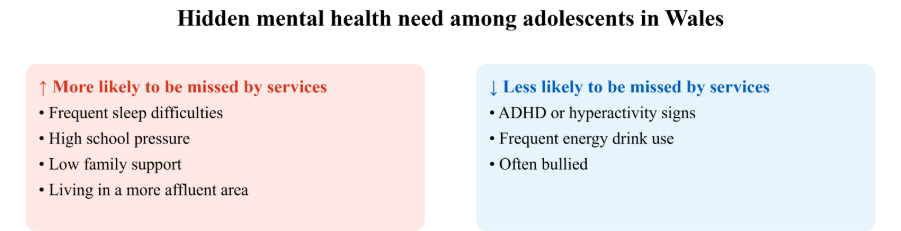
Young people with potential unmet need were more likely to self-report:
- Sleep difficulties
- Feeling under high academic pressure
- Low family support
Factors associated with greater visibility in routine NHS data
Young people who reported being bullied, had markers of possible neurodevelopmental difficulties, or reported very heavy energy drink use were more likely to have a recorded contact with one of the included NHS services.
By contrast, markers of possible neurodevelopmental difficulty and very heavy energy drink use were associated with lower odds of potential unmet need, meaning these adolescents were more likely to have a recorded contact with one of the included NHS services.
Variation by sex and deprivation
The analysis also found variation by sex and deprivation. Girls were more visible in some datasets, while service contact patterns also differed across levels of socioeconomic deprivation.
These patterns suggest that some groups may be more visible in routine data than others. The finding that adolescents in less deprived areas were more likely to have no recorded contact with the included NHS services, despite high psychosocial need, should be interpreted cautiously. It may reflect differences in help-seeking, service pathways, or support received outside the NHS datasets captured here, such as school-based, voluntary sector or private counselling support. Further analysis could explore whether this pattern differs when using mental health-related contacts rather than any NHS contact.
Why this matters
The findings suggest that routine NHS service data may not fully represent adolescent psychosocial need in the wider population. They should not be read as evidence that all young people who are not visible in these datasets require referral to specialist CAMHS. Rather, they show the limits of using NHS contact data alone to assess population need and support the case for a graduated response across universal, targeted and specialist provision.
The study points to several practical areas where earlier identification may be possible. Sleep problems, school pressure and low family support emerged as markers associated with potential unmet need. By contrast, young people who reported bullying were more likely to have a recorded contact with an included NHS service. These patterns may help inform prevention, identification and earlier support.
Implications for policy and practice
The results support a whole-system response consistent with the NYTH/NEST Framework, rather than an assumption that gaps should be filled by NHS CAMHS alone. Schools, families, trusted adults, community and voluntary organisations, local authority services, primary care and specialist mental health services each have a role. Support should be easy to access, proportionate to need and connected across settings, with clear routes to specialist assessment and treatment for young people with more severe or complex needs.
Linked data can also help improve understanding of who is being missed and where inequalities persist. This could support better planning, more equitable access, and more targeted interventions for young people at risk of hidden distress.
Conclusion: A large group of adolescents in Wales appear to have substantial psychosocial difficulties without recorded contact with the health services captured in this analysis. Responding to this potential hidden need requires a coordinated, multiagency approach: strengthening the everyday environments and relationships that protect mental health, providing accessible early help for mild-to-moderate difficulties, and ensuring timely specialist care where clinically appropriate. Better integration of school-based approaches, family and community support, service pathways and linked data may help identify need earlier without equating all unmet need with a need for CAMHS.
Conclusions and policy recommendations
This work supports a dual approach: measuring and addressing mental health difficulties and mental well-being together gives a fuller picture than either measure alone. The findings also highlight modifiable drivers that can be targeted through prevention and early support.
Policy and Practice Recommendations
- Track both mental health difficulties and mental well-being nationwide
- The two provide different but complementary insights, and both matter.
2. Target modifiable risk factors
- Sleep hygiene
- Bullying prevention
- Academic pressure reduction
- Strengthening family and peer support
- Improving teacher connectedness
3. Strengthen integrated school–health systems
- Schools are well-placed for early identification, but need:
- clear referral pathways
- timely access to services and support
- support to deliver universal and targeted interventions
4. Address inequalities
- Visibility in routine NHS data varied by sex and deprivation, suggesting that some groups may be less visible through existing healthcare pathways than others.
- Planning and resource allocation should consider these differences, while maintaining universal support alongside additional targeted effort for groups at greater risk of being missed.
5. Use linked data to inform whole-system approaches to population health. Linking survey and health record data reveals patterns of service visibility and potential hidden need in a way that neither data source can achieve alone.
What this work adds
Taken together, this work shows that mental health difficulties and mental well-being are related but distinct, and that measuring both provides a fuller picture of young people’s needs in Wales.
It identifies several modifiable factors — including sleep difficulties, academic pressure, bullying and peer problems, negative body image, and perceived support from teachers, friends and family — that are associated with both higher difficulties and lower well-being.
It also shows that routine NHS data alone may not capture all young people with high psychosocial need, highlighting the value of combining school survey data with linked health records to better understand population need, visibility in services and opportunities for earlier support.
For more information
- SHRN website: https://www.shrn.org.uk/
- Data access: SAIL Databank (subject to governance approval)
- Public Health Wales needs assessment: Health Needs Assessment: Mental Health of Babies, Children and Young People in Wales
- Lead contact: Giles Greene, Population Health Linked Data Research Lead, Public Health Wales
References
- World Health Organisation (2014) Health for the world’s adolescents: A second chance in the second decade. Geneva: WHO.
- World Health Organization (2021) Adolescent mental health. Geneva: WHO.
- Ford, T., John, A. and Gunnell, D. (2021) ‘Mental health of children and young people during pandemic restrictions’, British Medical Journal.
- Weare, K. (2017) Promoting mental, emotional and social health: A whole school approach. London: Routledge.
- Suldo, S.M. and Shaffer, E.J. (2008) ‘Looking beyond psychopathology: The dual-factor model of mental health in youth’, School Psychology Review, 37(1), pp. 52–68.
- Kinderman, P., Schwannauer, M., Pontin, E. and Tai, S. (2015) ‘Psychological processes mediate the relationship between social factors and mental health outcomes’, Psychological Medicine.
- Sharpe, H., Patalay, P., Vostanis, P., Belsky, J. and Wolke, D. (2016) ‘Exploring the relationship between mental health difficulties and wellbeing in adolescence’, Journal of Adolescence.
- Goodman, R. (1997) ‘The Strengths and Difficulties Questionnaire: a research note’, Journal of Child Psychology and Psychiatry, 38(5), pp. 581–586.
- Goodman, R., Meltzer, H. and Bailey, V. (1998) ‘The Strengths and Difficulties Questionnaire: a pilot study on the validity of the self-report version’, European Child & Adolescent Psychiatry, 7, pp. 125–130.
- Stewart-Brown, S., Tennant, A., Tennant, R., Platt, S., Parkinson, J. and Weich, S. (2009) ‘Internal construct validity of the Warwick–Edinburgh Mental Well-being Scale (WEMWBS): a Rasch analysis using data from the Scottish Health Education Population Survey’, Health and Quality of Life Outcomes, 7, 15.
- Ng Fat, L., Scholes, S., Boniface, S., Mindell, J. and Stewart-Brown, S. (2017) ‘Evaluating and establishing national norms for mental wellbeing using the short Warwick–Edinburgh Mental Well-being Scale (SWEMWBS): findings from the Health Survey for England’, Quality of Life Research, 26(5), pp. 1129–1144.
- Keyes, C.L.M. (2002) ‘The mental health continuum: From languishing to flourishing in life’, Journal of Health and Social Behavior, 43(2), pp. 207–222.
- Westerhof, G.J. and Keyes, C.L.M. (2010) ‘Mental illness and mental health: The two continua model across the lifespan’, Journal of Adult Development, 17(2), pp. 110–119.
- School Health Research Network (SHRN) (n.d.) The School Health Research Network (SHRN). Available at: www.shrn.org.uk (Accessed: 8 June 2026).
- Page, N., Liu, S., Morgan, K., Angel, L., Ogada, E., Roberts, C., Young, H. and Murphy, S. (2024) ‘Data Resource Profile: The School Health Research Network (SHRN) Student Health and Well-being (SHW) survey of 11–16-year-olds (2017–2023)’, International Journal of Epidemiology, 53(6), dyae161.
- Office for National Statistics (2018) Children’s well-being and mental health: UK. London: ONS.
- Public Health Wales (2025) Joint Statement on Children and Young People’s Mental Health and Wellbeing: November 2025. Cardiff: Public Health Wales.
- Public Health Wales (2026) Health Needs Assessment: Mental Health of Babies, Children and Young People in Wales, Cardiff: Public Health Wales.
- Guo, X., Mueller, M.A.E., Armitage, J.M., Bonell, C., Ford, T.J., John, A., Lewis, G., Murphy, S., Ploubidis, G., Rice, F., Sullivan, A. and Lewis, G. (2026) ‘The association between academic pressure and adolescent depressive symptoms and self-harm: a longitudinal, prospective study in England’, The Lancet Child & Adolescent Health, 10(4), pp. 265–272. doi: 10.1016/S2352-4642(25)00342-6.