

Analysing the effectiveness of treatments offered by Stop Smoking Wales (2019)
Authors: Analysis Team
Published on: 5th May 2020
Next update: To be announced
Contact for queries or feedback
This short report compares the effectiveness of treatments and intervention settings offered by Stop Smoking Wales (SSW) in helping clients achieve a 4 week CO-validated quit.
Introduction
Tobacco is a major public health concern and the leading single cause of premature death in Wales. Although smoking rates have continued to decline in recent years, around one in five adults still report to be a current smoker (Welsh Government 2017).
Stop Smoking Wales (SSW) is an NHS Wales smoking cessation service provider, which provides medication and behavioural support sessions for smokers that want to quit. This study evaluated SSW as a service and assessed the effectiveness of medications and intervention settings offered in achieving a four-week CO-validated quit.
Key messages
The results in this section have been adjusted for the other variables that were included in the final model.
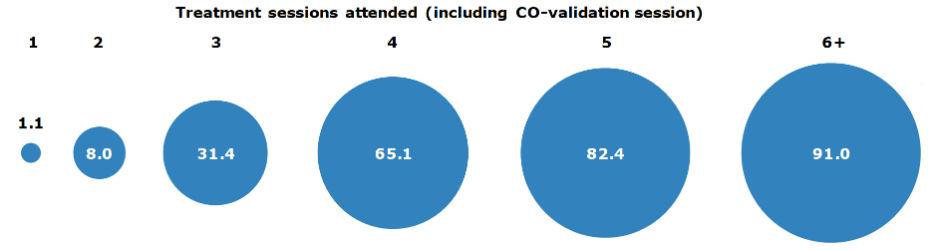
The strongest indication that a client would quit smoking was associated with the number of treatment sessions they attended. Ninety-one percent of clients that attended six or more sessions achieved a CO-validated quit at four weeks compared to only one percent that attended one session (figure 1).
Figure 1: Stop Smoking Wales attendees achieving a 4 week CO-validated quit by number of treatment sessions attended, percentage, persons aged 16+, Wales, 2015/16
There was some evidence to suggest that clients that used varenicline and attended rolling group sessions were more likely to quit smoking when compared to the reference group. However, clients that used varenicline and attended one-to-one sessions were not statistically significantly more likely to quit than the reference group (table 1).
Table 1: Stop Smoking Wales attendees achieving a 4 week CO-validated quit by treatment and setting, odds ratio, persons aged 16+, Wales, 2015/16
| Medication type | Setting | Odds ratio (95% confidence interval) | p-value |
|---|---|---|---|
| Nicotine replacement therapy | Closed group | 1 (reference group) | |
| Varenicline | Rolling group | 3.62 (1.00 to 13.14) | 0.051 |
| Varenicline | One to one sessions | 1.20 (0.30 to 4.75) | 0.799 |
Smokers that had a moderate or very low nicotine dependence score had statistically significantly increased odds of quitting compared to those with a high nicotine dependence.
Almost 5,500 treated smokers (clients that attended at least one treatment session) progressed through the SSW treatment pathway. Of these, over 52% completed the intervention.
Conclusion
Varenicline and group behavioural support was found to be the most effective combination of treatment offered although the results were marginally non-statistically significant. Client retention throughout the SSW pathway is also of importance, as there was a clear dose-response effect in terms of treatment sessions attended and likelihood of quitting.
Background to the study design and statistical analysis
The study was a retrospective cross-sectional analysis using data provided by Stop Smoking Wales. Clients classed as treated smokers between 1st April 2015 and 31st March 2016 were included in the study population.
The outcome of interest was those that achieved a four week CO-validated quit. The main explanatory variables were the medication and treatment settings offered by SSW although other factors including nicotine dependence and socio-economic status were adjusted for.
A descriptive analysis of the baseline data and attrition rates for each stage of the service were calculated. The data were modelled using stepwise regression to retain significant covariates and test for interaction terms. This ensured that contributing factors were adjusted for and significant interactions were accounted for. All statistical analyses were carried out using STATA 14.
Strengths and limitations
The study used standard analyses and criteria to ensure that the findings were comparable with similar smoking cessation studies. The study was based on all SSW attendees in Wales rather than a subset of the population. This allowed for a sufficiently large sample size and minimised selection bias.
Participants that voluntarily attend a smoking cessation intervention may be more motivated to quit than the general smoking population. They are therefore systematically different to regular smokers, which may limit the generalisability of the findings of this study.
Get in touch
We are always looking to improve on the products we produce to ensure that they are user-friendly. If you have any comments or feedback on the SSW report, then please get in touch with us by emailing.
Data tables
Access the data related to this annual report
Copyright notice
Copyright 2019 Public Health Wales NHS Trust.
Material contained in this document may be reproduced under the terms of the Open Government Licence (OGL) http://www.nationalarchives.gov.uk/doc/open-government-licence/version/3/ provided it is done so accurately and is not used in a misleading context.
Acknowledgement to Public Health Wales NHS Trust to be stated.
Copyright in the typographical arrangement, design and layout belongs to Public Health Wales NHS Trust.