Your antenatal blood test result: you are a haemoglobin Lepore carrier
You should read this information if the result of your antenatal screening blood test for sickle cell and thalassaemia (SCT) shows you are a haemoglobin Lepore carrier. Some people call this ‘having a trait’. This leaflet gives you information about being a carrier, and what this means for you and your family.
Published January 2022
Contents
― Being a carrier
― Your baby
― Chances of inheriting a serious condition
― Inherited haemoglobin conditions
― Thalassaemia major
― Sickle cell disorder
― Next steps and choices
― Newborn Screening
― Other family members
― Future pregnancies
― How your test result is written
― More information
Being a carrier
Being a carrier does not make you ill. You will not develop a haemoglobin condition that needs treatment but it is important to know that you can pass the haemoglobin Lepore gene on to your baby. If the baby’s biological father is also a carrier, together you could have a baby with a serious inherited condition. The chance is the same in every pregnancy.
Haemoglobin is the substance in red blood cells that carries oxygen around your body. Being a carrier means you have inherited one usual haemoglobin gene called haemoglobin A from one biological parent and one haemoglobin Lepore gene from your other biological parent. Because you have inherited usual haemoglobin A from one parent, you are healthy.
If your baby’s biological father has an unusual haemoglobin gene it is important to identify the type of gene and the chance of your baby inheriting a serious haemoglobin condition. For this reason, we will also invite the biological father for screening. He will only know if he carries a gene for unusual haemoglobin if he has a blood test to check his haemoglobin type.
If the test shows the biological father is a carrier of an unusual haemoglobin gene you will be offered specialist counselling and, if necessary, invasive testing.
Please let your healthcare professional know if you:
- became pregnant as a result of fertility treatment with donor sperm or a donor egg;
- have had a bone marrow or stem cell transplant; or
- are pregnant as a surrogate.
Your baby
There are a number of different haemoglobin conditions your baby could inherit. Some are more serious than others. The type and severity of the condition depends on the types of haemoglobin gene you and your baby’s biological father have.
The most serious conditions are thalassaemia major and sickle cell disorder. People who have thalassaemia major or sickle cell disorder need specialist care and treatment throughout their lives.
Chances of inheriting a serious condition
One biological parent is a carrier and the other is not
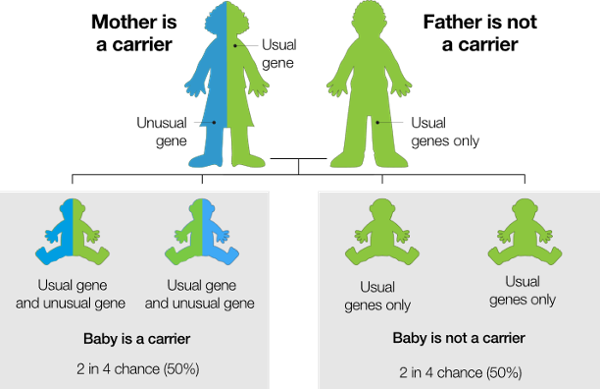
If your baby’s biological father has two usual haemoglobin genes (AA), there is a 2 in 4 (50%) chance your baby will be a haemoglobin Lepore carrier (like you) and a 2 in 4 (50%) chance they will have two usual haemoglobin genes (AA).
See diagram below. These chances are the same in every pregnancy for this couple.
Both biological parents are carriers
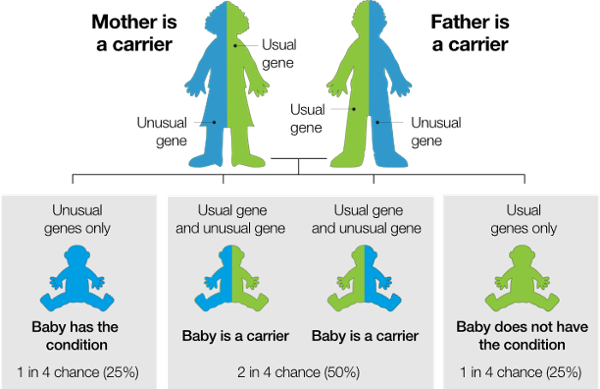
If the baby’s biological father is also a carrier, there is a 1 in 4 (25%) chance your baby will inherit a haemoglobin condition. The seriousness of the condition will depend on what haemoglobin genes are inherited.
There is also a 2 in 4 (50%) chance your baby will be a carrier, and a 1 in 4 (25%) chance your baby will have usual haemoglobin genes (AA).
See diagram below. These chances are the same in every pregnancy for this couple.
Inherited haemoglobin conditions
Haemoglobin conditions are blood disorders inherited from both biological parents.
There are a number of haemoglobin conditions, but the type of condition that your baby could inherit will depend on what types of haemoglobin genes both biological parents have. Some conditions are more serious than others.
The most serious conditions are called thalassaemia major and sickle cell disorder. People who have these conditions will need specialist care and treatment throughout their lives.
If your baby’s biological father is a beta thalassaemia carrier, there is a 1 in 4 (25%) chance that your baby could inherit thalassaemia major (the specific condition is called haemoglobin Lepore/beta thalassaemia). This can either be a serious condition that requires specialist care and treatment, or a mild condition that only occasionally requires treatment. Your healthcare professional will be able to explain this to you in more detail.
There is also a 2 in 4 (50%) chance your baby could be a carrier, or a 1 in 4 (25%) chance that your baby could have the usual haemoglobin AA.
If your baby’s biological father is a sickle cell carrier there is a 1 in 4 (25%) chance that your baby could inherit sickle cell disorder. This is a condition that requires specialist care and treatment.
If your baby’s biological father carriers the gene for a different unusual haemoglobin, for example delta beta thalassaemia or haemoglobin Lepore, there is a 1 in 4 (25%) chance that your baby could inherit a different haemoglobin condition. The seriousness of the condition will depend on which genes are inherited. You can discuss this with your health professional, so that you understand exactly what condition your baby could inherit.
Thalassaemia major
People with thalassaemia major:
- are very anaemic (their blood has difficulty carrying oxygen);
- usually need blood transfusions every month; and
- need medicines (iron chelation therapy) to stop the iron overload which is a result of the monthly blood transfusions.
Sickle cell disorder
People with sickle cell disorder have red blood cells that can become misshapen when they release oxygen around the body. This can block small blood vessels.
People with sickle cell disorder:
- can have attacks of very severe pain;
- can get serious, life-threatening infections;
- are usually anaemic; and
- need medicines and injections when they are children and throughout the rest of their lives to prevent infections.
Next steps and choices
If screening shows your baby could inherit a serious haemoglobin condition you will be offered specialist counselling and invasive testing.
Newborn screening
All babies are offered a newborn blood spot screening test five days after their birth. This test will screen for sickle cell disorder.
You can also:
- let your GP or healthcare professional know you are a haemoglobin Lepore carrier;
- contact a specialist sickle cell thalassaemia centre where you can get free information and advice to help you understand the implications of being a haemoglobin Lepore carrier; and
- organise for any other children you have to be tested if needed, with help from your GP or sickle cell thalasaaemia centre.
Other family members
As you are a haemoglobin Lepore carrier, other members of your biological family could be carriers too.
We recommend you talk to your parents, brothers, sisters, uncles, aunts and cousins, and encourage them to get a test before they start a family or have any more children. Showing them this information may help.
It is equally important for men and women to be tested. Anyone can ask for a test at any time from their GP or from a specialist sickle cell thalessaemia centre.
Future pregnancies
We recommend you tell your healthcare professional about your carrier status as early as possible in any future pregnancies.
It is important to test the baby’s biological father and be referred to a specialist counsellor.
How your test result is written
As a haemoglobin Lepore carrier your screening result is written Hb A/Lepore.
The letter A represents your usual haemoglobin A gene. Lepore is the name of unusual gene you carry.
More information
You can get more information from the following.
https://111.wales.nhs.uk/encyclopaedia/t/article/thalassaemia/